
I’ve been in Poland this week for a summer campus bringing together Polish and Latvian historians, journalists, history enthusiasts, collectors of militaria, searchers for lost militaria, people who know the local history and people keen to find out more.
Nearly 20,000 Latvians, mostly young conscripts, were sent to an SS training camp in Pomerania – the SS-Truppenubungsplatz West Preussen – from August 1944 onwards. They were to be trained to fight the Red Army, which was about to cross the Vistula in massive numbers.
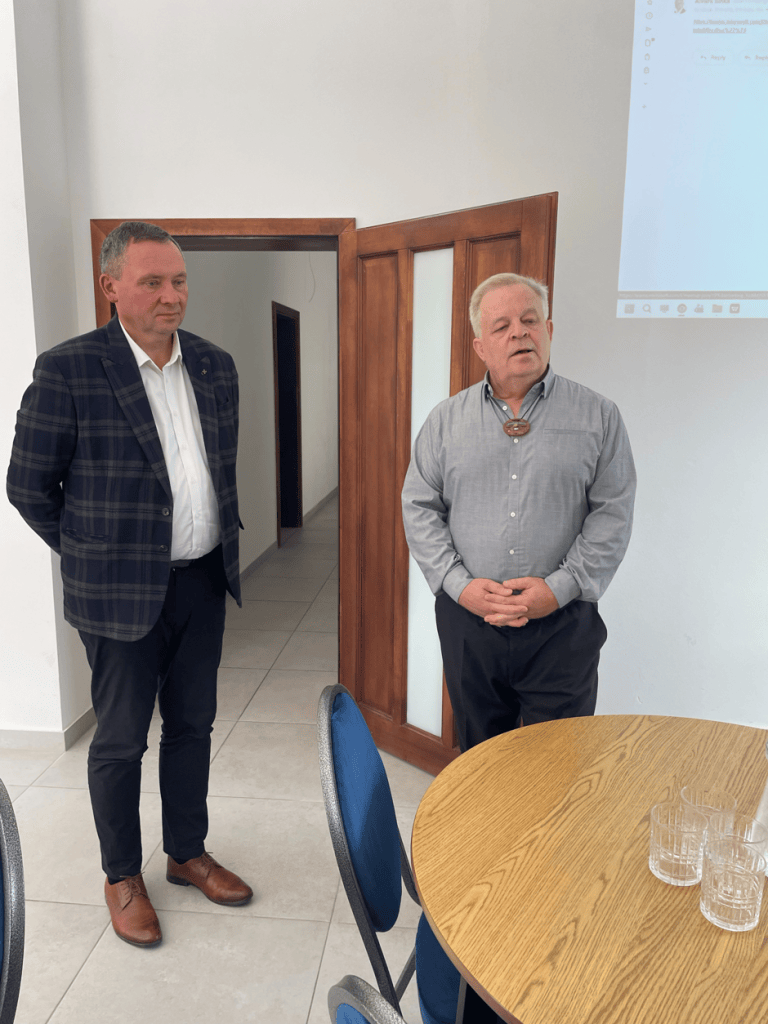
One of the many villages the Latvians were sent to was Lipusz, in a beautiful area of lakes and forests called Kashubia, about 90 kilometres west of Gdansk. Our campus was opened by the Latvian ambassador to Poland, Raimonds Jansons, and the Mayor of Lipusz, Miroslaw Ebertowski.
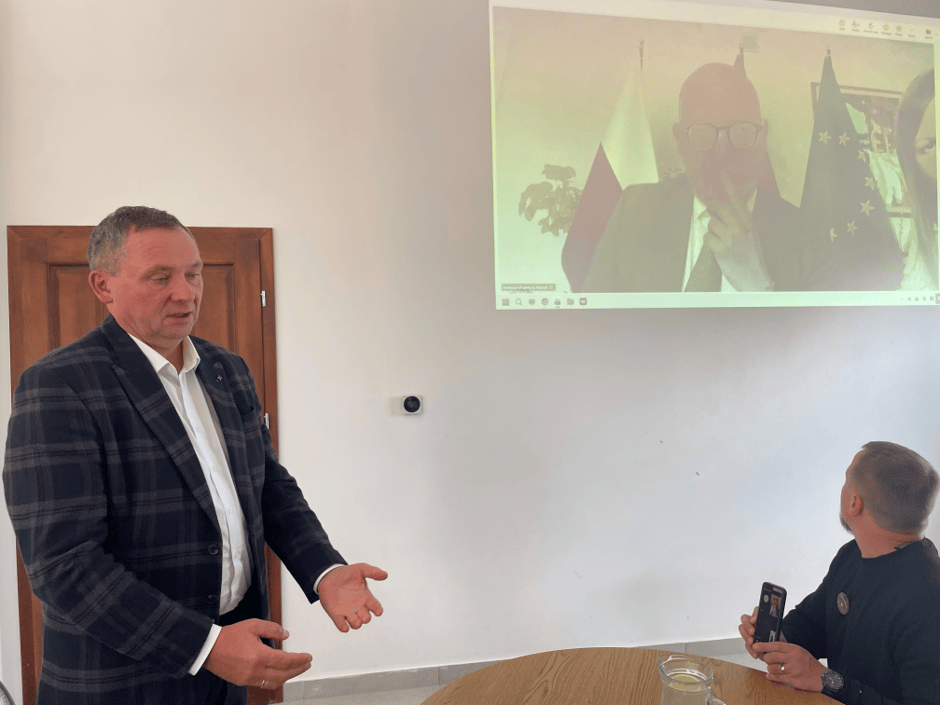
Having a Polish Mayor and a Latvian ambassador open the campus is in itself is a signal of how important such a partnership could be. The Nazis cleared most of the Polish out of these villages after the 1939 invasion, and the Latvians who were there were sent to the front and either died in action or retreated to the West, where they surrendered to the Allies and never returned home because of the Soviet occupation of Latvia.
There are few records of what happened, and the period from summer 1944 to May 1945 is more or less a black hole for both countries – on the surface, at least. The Bridges of Friendship project is designed to address that, and fill in the gaps on both sides.
On the Latvian side the Daugavas Vanagi veteran’s association chairman Aivars Sinka brought historian Dace Leja from the Latvian War Museum and Roberts Romanovskis from the Stura Maja KGB museum: Polish representation was arranged by campus director Jan Delingowski and included several teenagers keen to find out more about that time – and to dig for answers.
Ambassador Jansons spoke very well. “During the final months of the Second World War approximately 20,000 Latvian soldiers found themselves in Pomerania,” he said, via a video link. “Many had been conscripted, many were very, very young. They arrived in Pomerania at a time when their own country was already occupied and had lost its independence.
“I would say that for months Latvian and Kashubian lives crossed in villages, in roads, in forests and farms. They had encounters and those encounters were of course part of the very much larger tragedy. They also produced something that does not always find its way into the official histories – they produced human connections.
“Sometimes, when we talk about those connections, they were as simple as a piece of bread given to a stranger, and sometimes those connections are still in existence, in the form of the memory of a song heard by a child more than 80 years ago and the song is still remembered.”
Mayor Ebertowski welcomed the initiative, and suggested that Lipusz was a place where ‘the Bridges of Friendship’ between Latvians and Polish might begin their work to examine the joint history here. This was such a good idea we decided to adopt his term.
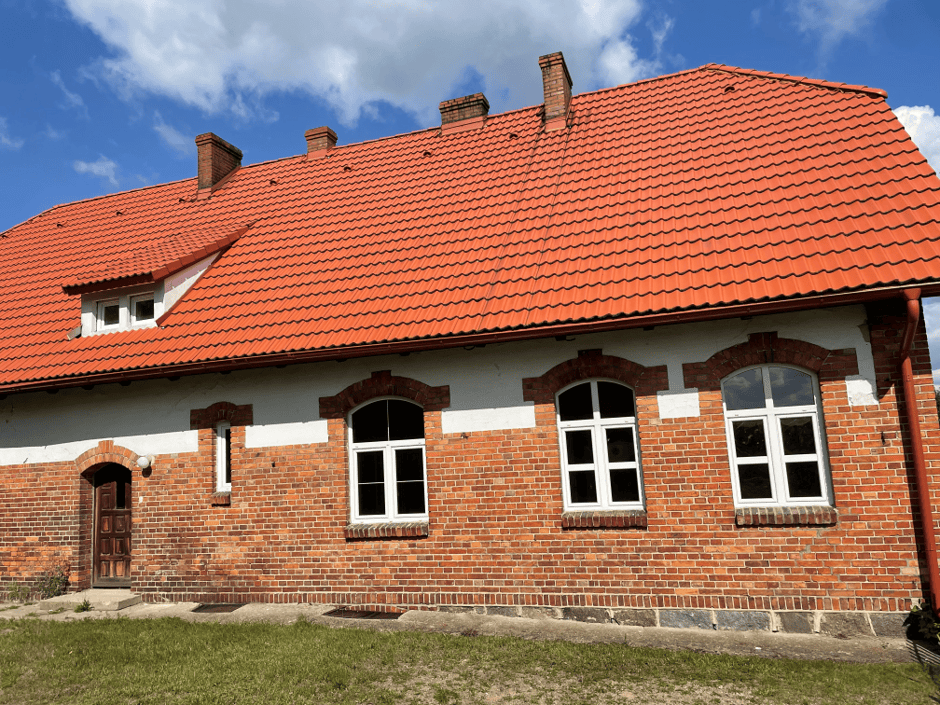
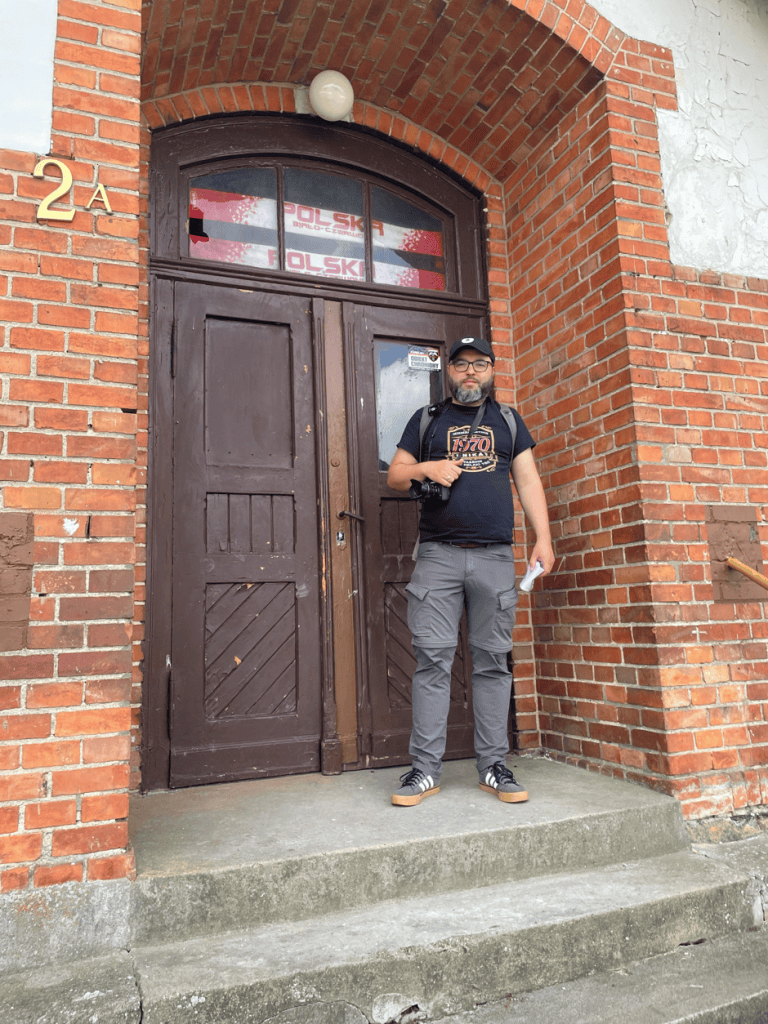
With Latvian historian and journalist Viesturs Radovics coming to the camp to report for the news website Delfi.lv, we went to a school in the nearby village of Tuszkowy which had once been the headquarters of the 33rd Regiment of the Latvian 15th SS Division.
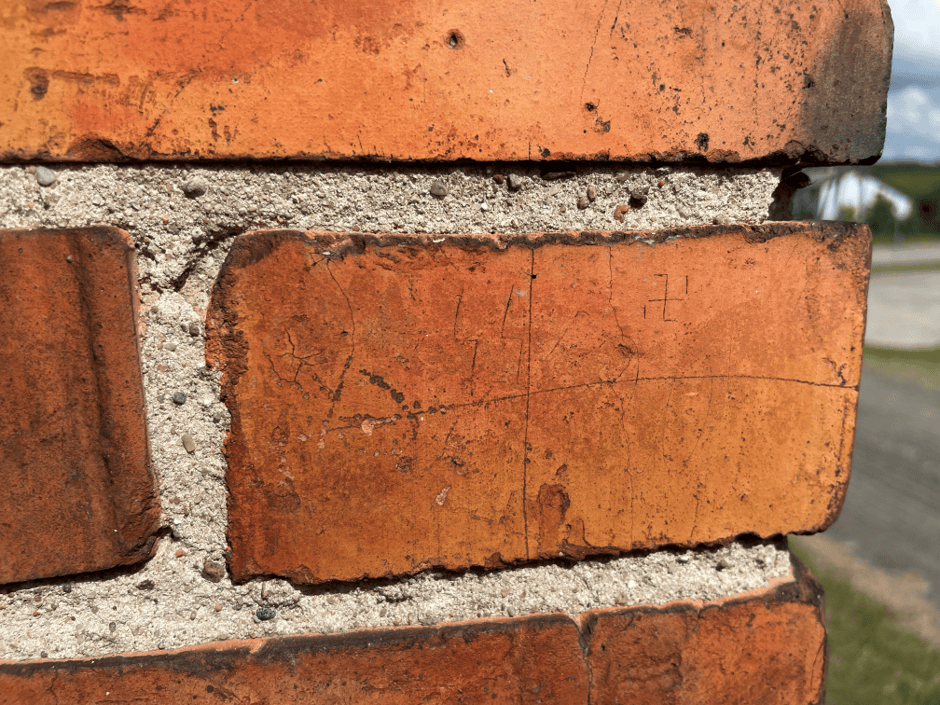
We spread out and began to look for signs of a German military presence in this area. Eagle-eyed researchers quickly found it: ‘SS’ scratched into a brick, alongside a swastika.
But then Viesturs spotted something with a much more Latvian flavour scratched into another brick: a name and a date: ‘M.Zakis, 1944,12.9.’
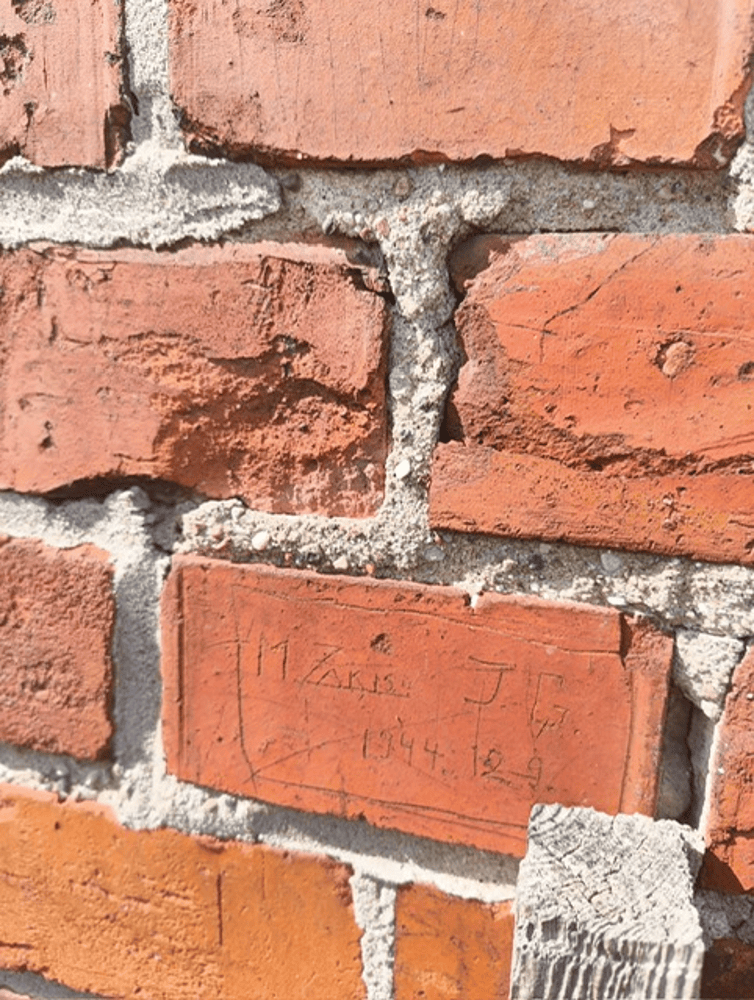
This matches exactly the time frame when the Latvians would have been based here. Viesturs went on to trace Martins Zakis’ later life – he survived the war and ended up in the prisoner camp at Zedelghem in Belgium. As Viesturs is writing a book about the Latvians in the SS training camp in Kashubia, I’ll leave it there.
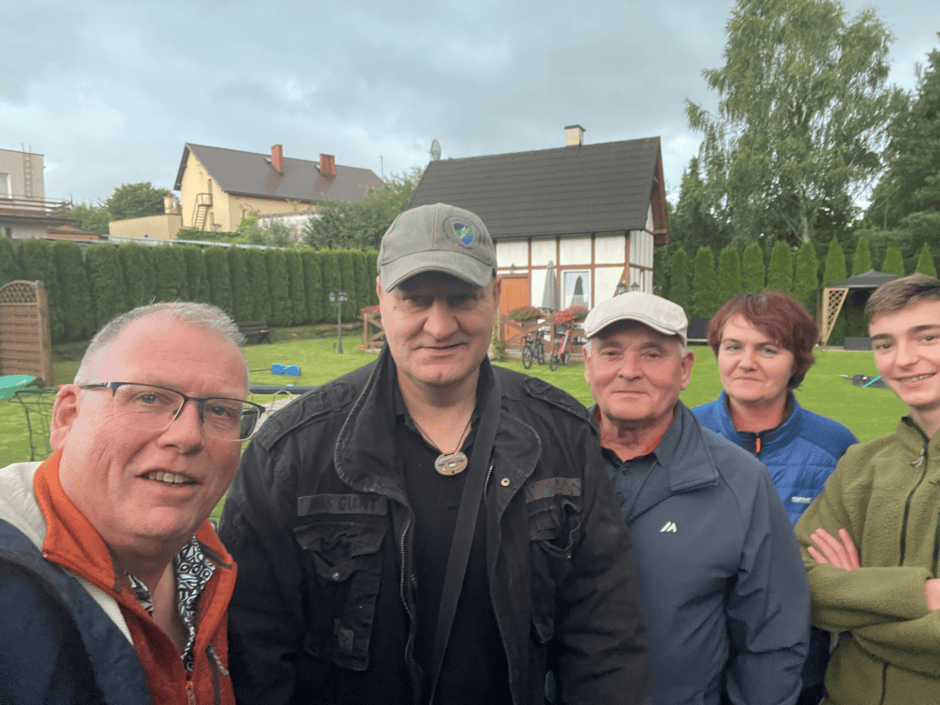
The aim of the campus was to bring Latvians and Polish together, and people who had lived there for generations turned up to bring stories, memories and maps. One highlight was when Arek (second from left) brought a hand-drawn map of a PoW camp in Lipusz that is not well-documented, along with an audio cassette of the memories of a Polish man held there. The map was in Polish, so I asked our young Polish enthusiast Tymek (right) to translate it into English. Then we compared it to a map from 1920 and the fixed points like the railway and houses that were then then and are now, and we managed to locate the perimeter of the camp from a hand-drawn, not-to-scale map in Polish.
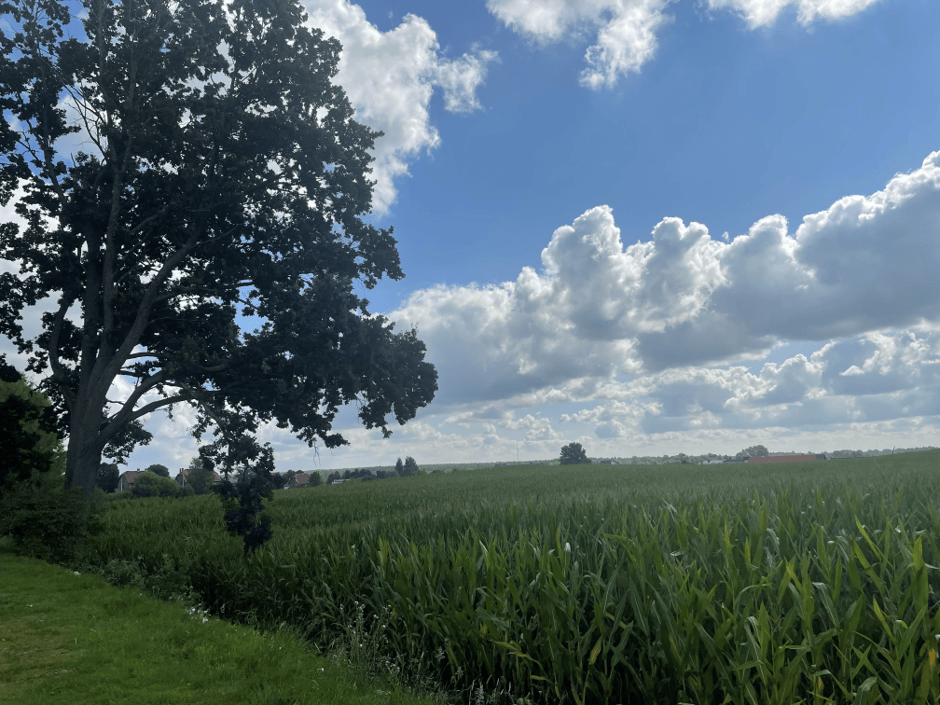
This area was confirmed by Wieslaw and Karola (centre) whose families have lived in the area for several generations. So that’s the next job – to survey and chart where the various elements of the camp were. One part is currently used as a cornfield…
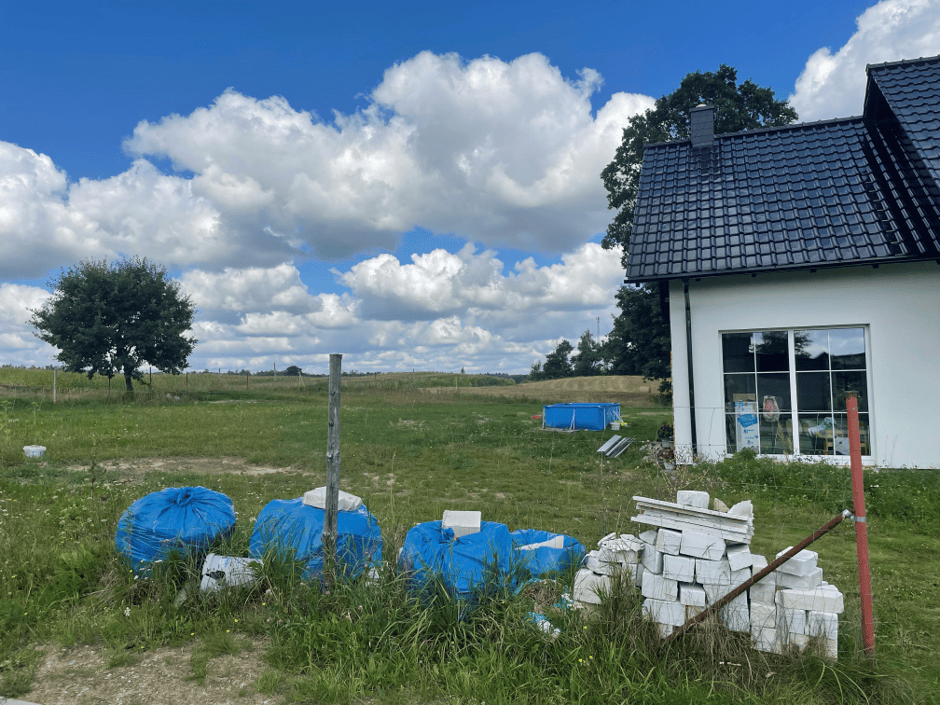
…while another, behind these houses, is where the narrow gauge railway linked up with Lipusz station.
The reception we received in Lipusz was fantastic and the generosity was extraordinary. There were cakes and coffee every day to keep us refreshed and phone calls were made to the elders of the village to come and share their stories.
You’ll have noticed in the Latvian ambassador’s remarks that sometimes these shared memories come in the form of a song. One 95 year old man, Stanislaw Tiborski, living in the border village of Sominy, was five when the war started and ten when the Latvians arrived in this area – to be billeted in his mother’s house: his family of eight siblings and his Mum in one room, the Latvians in the other. They set up a field kitchen in the back garden and shared their food with the kids.
Before long they were teaching them songs. Stanislaw had stunned us on a previous visit by suddenly bursting into a song he remembered from 80 years ago which he had learned phonetically from these Latvian soldiers – he kindly agreed to sing ‘The Blue Scarf’ for Delfi.lv, and the Latvians sang along with him.
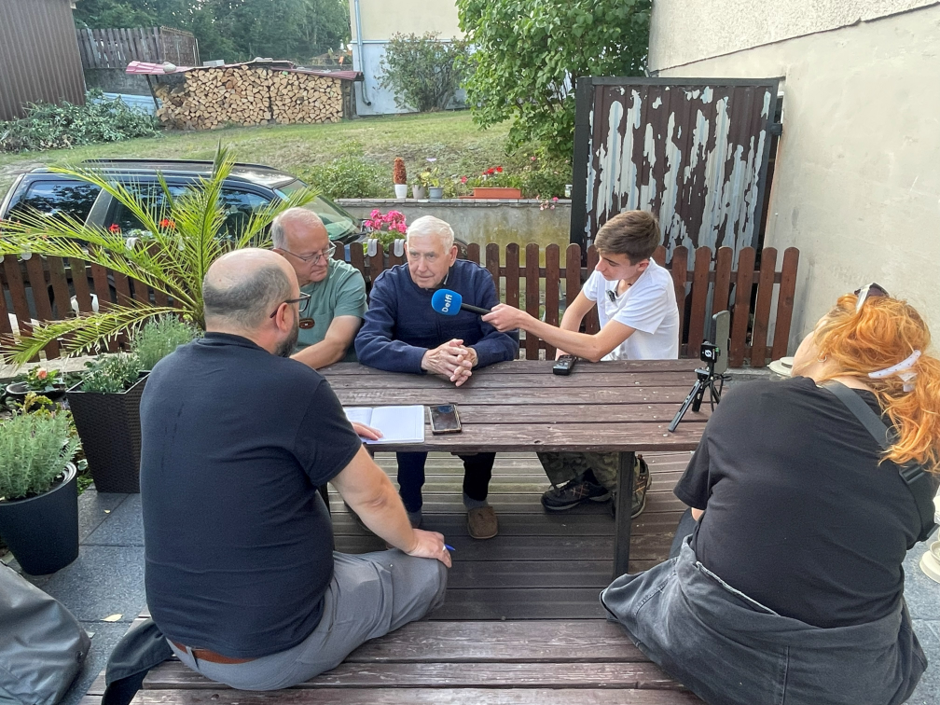
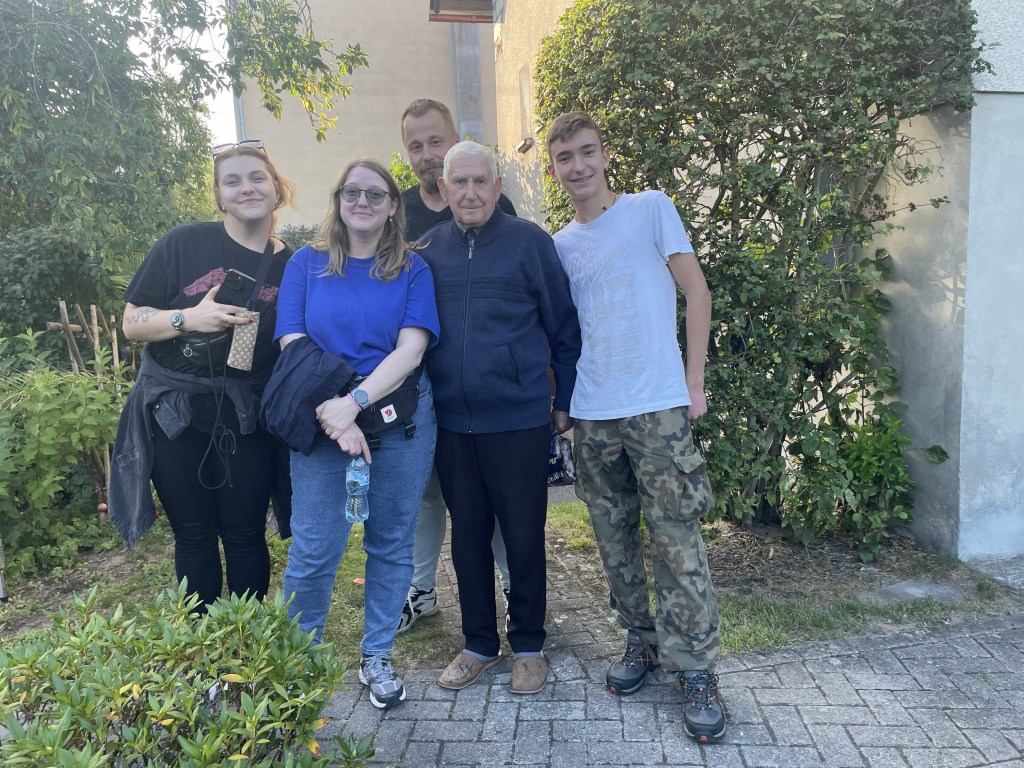
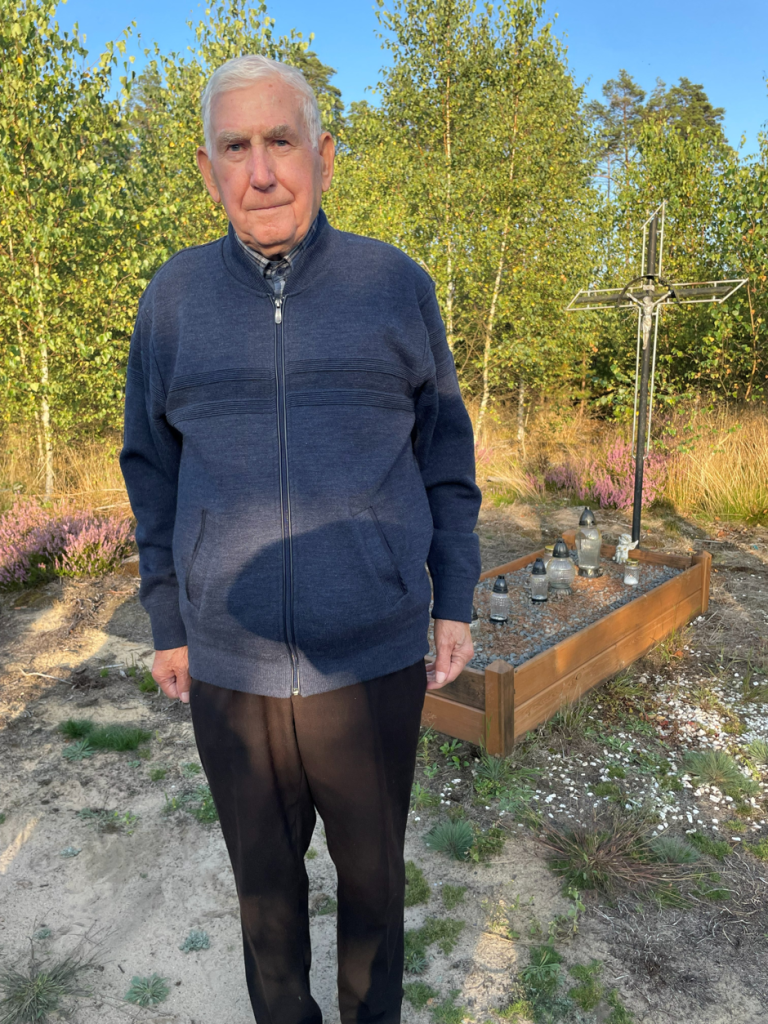
Stanislaw became fond of the Latvian soldiers, and when one man was killed by a Soviet plane in a machine gun attack on a nearby hillside and buried there, he tended his grave for the rest of his life. He took the camera crew up there and lit a candle at the grave. The soldier’s body has recently been removed under the programme to relocate fallen soldiers to cemeteries, but that’s an extraordinary commitment.
My particular favourite moment was when we found – by using extracts from the diaries of soldiers – the place where the Latvian soldiers were billeted in Tuszkowy: ‘a two-storey house by a lake’.
After talking to several of the residents of the village who were quite naturally curious about what we were doing, we got in our cars and – bingo. A two-story house … and a lake.
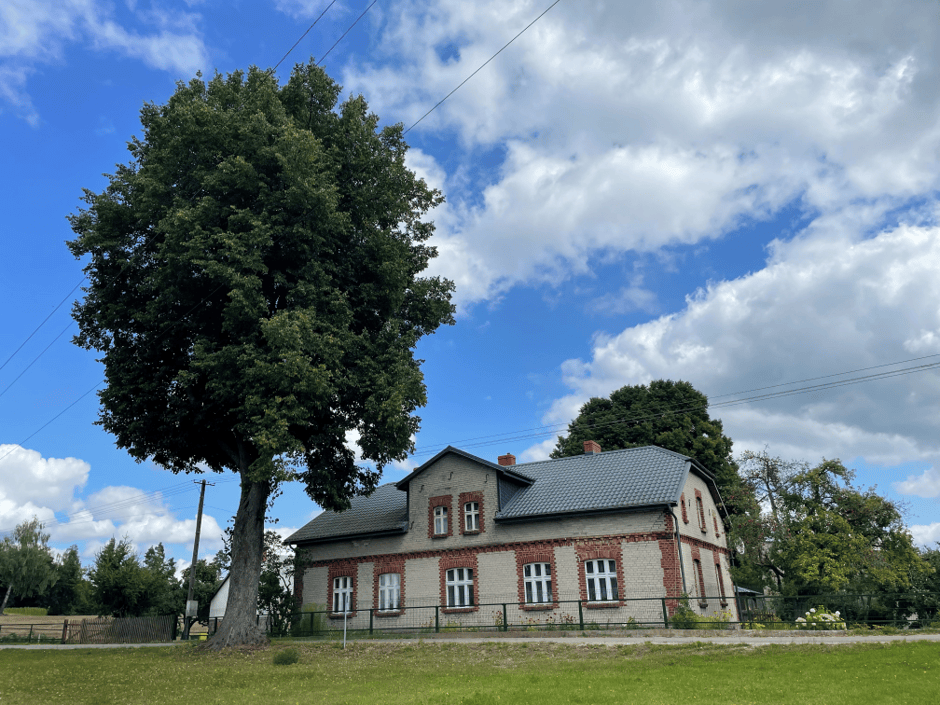
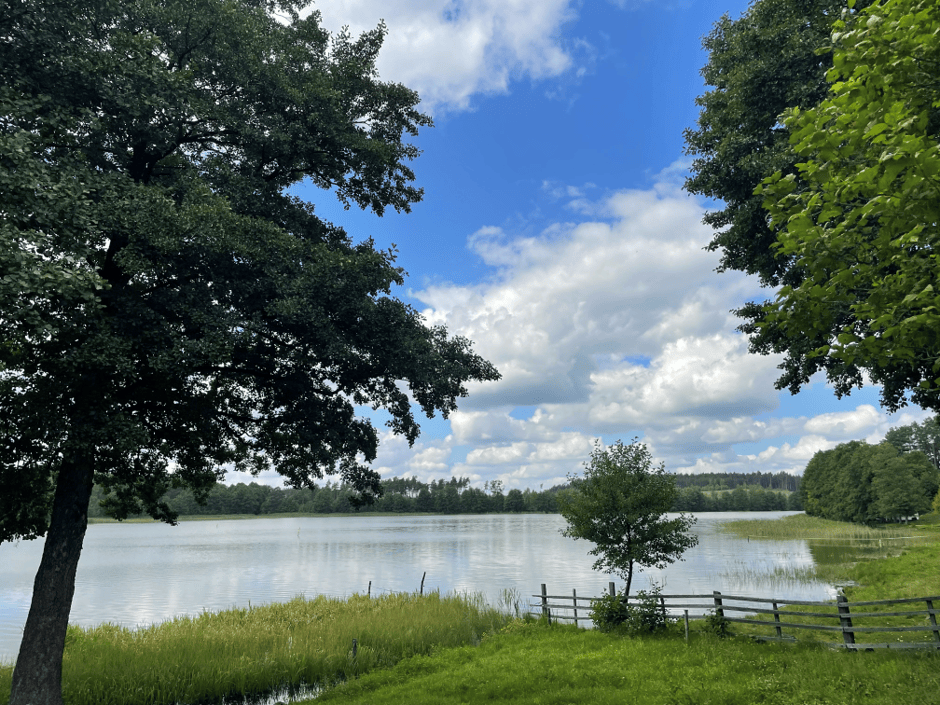
In such a beautiful spot, on such a lovely day, it’s not hard to imagine groups of 19 and 20 year old lads washing their uniforms in the lake, picking apples from the trees, lazing around on the grass, far from home but also far from the horrors of war that would soon descend upon them. Some of them thought they were in Czechoslovakia, as that was where they were told the training would happen.
As the camp closed local history enthusiast Karola Bober baked bread for all campus participants – an amazing gesture, as she got up at 4am to do this.
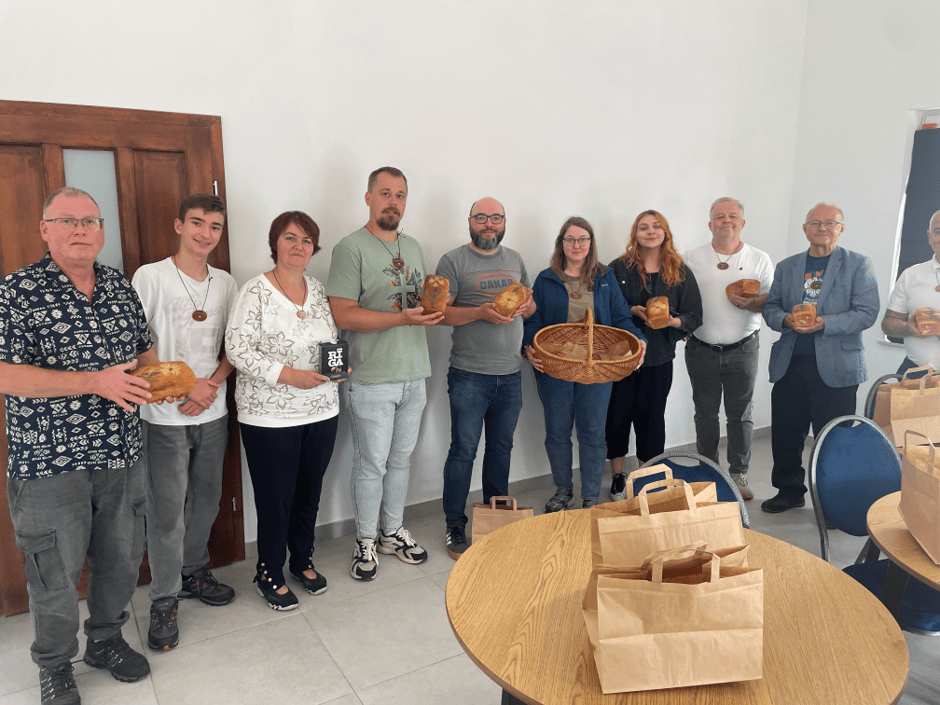
After Karola handed out her loaves of friendship, Aivars Sinka from the Latvian veterans’ association Daugavas Vanagi said:
“The giving and receiving of bread is highly symbolic and has always been. While we were here at the summer school, we heard the story of a Kashubian woman in Lipusz who, upon seeing starving young Latvian soldier recruits, went to the mill in the centre of town to beg some flour and then baked bread for them.
“When the Latvians came to Lipusz, they came wearing the uniforms of your occupiers and oppressors. We know that the story isn’t as simple as that, because the Latvians too were occupied and oppressed. But nevertheless, we shouldn’t forget those uniforms and what they represented. Thank you for being with us.”
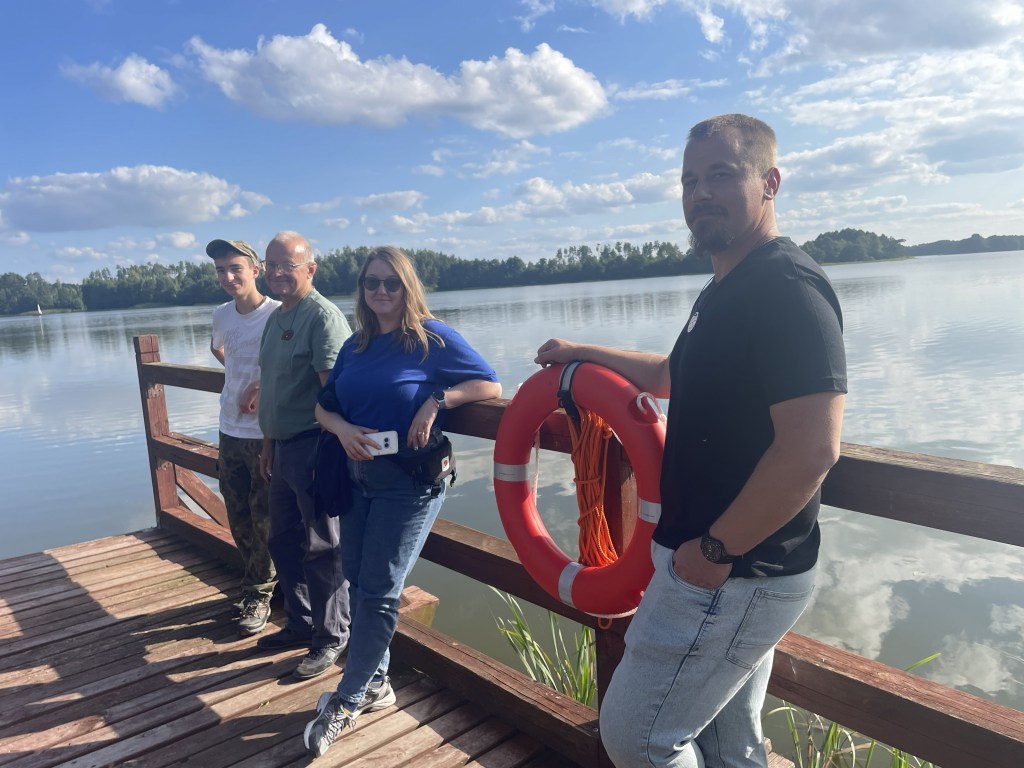
So a week of fantastic weather in a land of lakes and forests gave us an incredible start to the Polish-Latvian Bridges of Friendship project, now a two-way street with bread – and truth – as a common language. Let us build on that.
 Eastern Front Eyewitness